
Retainage in Construction: How to Calculate, Track and Release It
What retainage is, three worked calculations (flat 10%, a step-down to 5% at half complete, and stored materials), the bookkeeping entries, the release steps, and how retention works in the UK and the Gulf.
Nagi Software Team13 min read
Retainage is the part of each progress payment, usually 5% or 10%, that the owner holds back until the work is finished, as security that the contractor completes the job and fixes defects. You work it out on the running total of work completed (and often stored materials), book it apart from normal receivables, and bill for it once the contract's release conditions are met. We build retention into the client contracts in Nagi Construction Management Suite. Here are three worked calculations, the entries and the release steps.
What retainage is
Retainage (also called retention, holdback or retention money) is money earned but not yet paid. The owner keeps a percentage of every progress payment and releases it at the end, once the work is complete and accepted.
Owners hold it for three practical reasons: a lever to get the punch list finished, a cushion against defects found at handover, and protection against liens if a subcontractor or supplier goes unpaid. It flows down the chain, too. The owner holds retainage from the general contractor, and the GC usually holds the same rate, or more, from each subcontractor.
For the contractor, retainage is the profit on the job sitting in someone else's bank account. Take a $500,000 contract at 10%: $50,000 waits until the end. On a small firm's margin, that can be most of what the job earns. Read the retainage clause as closely as the price.
Who holds retainage
The party that pays holds it. For most private jobs that's the owner, keeping it in its own account; some contracts or state laws require an escrow account, and on lender-financed jobs the lender may hold back the same amount from its draws. On a subcontract, the general contractor holds the sub's retainage, whatever the owner is holding from the GC. A bond can replace cash retainage where the contract or law allows it.
What it costs you to carry
Put a number on it before you bid. Retainage builds up as you bill, so on a 12-month build the owner holds about half the final amount on average: $25,000. Then the full $50,000 waits through, say, six months of punch list and close-out. At 8% a year on your line of credit, that's $25,000 × 8% + $50,000 × 8% × 6 ÷ 12 = $4,000. That's real money on a job with a 10% margin, and it's why a step-down at 50% complete (example 2 below) is worth negotiating. To try your own figures, the draw schedule and cost-plus calculator builds a draw schedule with retainage and works out interest on loan draws.
How to calculate retainage: three worked examples
The rule behind all three: work out retainage on the total completed (and stored) to date, then compare it with what earlier applications already held. Never add up period-by-period amounts by hand. If someone revises a percentage, the running total corrects itself.
Example 1: a flat 10% on every application
A $250,000 subcontract with 10% retainage, billed monthly.
| Application | Work this period | Work to date | Retainage held to date | Payment due |
|---|---|---|---|---|
| 1 | $40,000 | $40,000 | $4,000 | $36,000 |
| 2 | $30,000 | $70,000 | $7,000 | $27,000 |
| 3 | $30,000 | $100,000 | $10,000 | $27,000 |
| 4 | $50,000 | $150,000 | $15,000 | $45,000 |
Payments to date total $135,000, which is $150,000 of work less $15,000 held. On application 4 the arithmetic is: $150,000 × 10% = $15,000 held in total, minus the $10,000 already held, so the owner holds $5,000 more this month and pays $45,000.
Example 2: reduced to 5% at 50% complete
A $600,000 contract holds 10% until the work is half complete, then "reduces retainage to 5%". At 50% ($300,000 to date) the owner holds $30,000. The next application brings the work to $450,000. What's held now depends on the exact words.
| How the clause is read | Retainage held at $450,000 | Earned less retainage | Payment due (previous certified: $270,000) |
|---|---|---|---|
| A. 5% on new work only | $30,000 + 5% × $150,000 = $37,500 | $412,500 | $142,500 |
| B. 5% on everything to date | 5% × $450,000 = $22,500 | $427,500 | $157,500 |
| C. No further retainage after 50% | $30,000 (5% of the contract sum) | $420,000 | $150,000 |
Reading B puts $15,000 more in the contractor's hands this month than reading A, and releases $7,500 the owner already held. None of the three is "standard". If you're pricing a job, ask for reading B in writing; if you're the owner, write reading A or C so nobody argues later.
Example 3: retainage on stored materials
An electrical subcontract: $180,000 of work completed to date and $40,000 of switchgear delivered and stored on site, not yet installed. The contract holds 10% on both.
| Line | Amount | Retainage |
|---|---|---|
| Work completed to date | $180,000 | $18,000 |
| Materials presently stored | $40,000 | $4,000 |
| Total completed and stored | $220,000 | $22,000 |
A common mistake is holding retainage on the $180,000 only. Then the application claims $4,000 too much. A reviewer who spots it sends the whole thing back. Next month, when the switchgear goes in, its $40,000 moves from "stored" to "work completed"; at a single 10% rate the retainage doesn't change. If your contract sets a different rate for stored materials, apply it only while they're stored, which is why AIA-style summaries split the retainage line in two.
Retainage on the pay application
A G702/G703-style application shows retainage in two places. The continuation sheet shows it per line, so the owner sees what's held on concrete separately from framing. The summary totals it, usually as two lines (retainage on completed work and on stored materials) that add to the total held. On AIA's own layout that's line 5. You take the total off "completed and stored to date" to get "earned less retainage", then subtract "previous certificates".
Retainage also sits inside the balance to finish. On our progress billing worked example, application 3 shows $327,500 completed and stored, $32,750 held, and a balance to finish of $203,750 "including retainage". The held money hasn't disappeared; it's still to be billed. Our free G702/G703-style pay application template has both retainage rates as settings and the per-line formulas in place. The free progress billing and retainage calculator works out an application for payment from your schedule of values, with change orders, retainage and stored materials.
Retainage receivable and payable in your books
Retainage you're owed is retainage receivable; retainage you're holding from others is retainage payable. Keep each in its own account. Mixing it into ordinary receivables makes your aging report look worse than it is, and your WIP schedule harder to read.
Using application 4 from example 1 ($50,000 billed this month, $5,000 held), the contractor's entry when the application is certified:
| Account | Debit | Credit |
|---|---|---|
| Accounts receivable | $45,000 | |
| Retainage receivable | $5,000 | |
| Contract revenue (or progress billings) | $50,000 |
When the owner releases the full $15,000 at the end, it moves from retainage receivable into a normal invoice and then to cash:
| Account | Debit | Credit |
|---|---|---|
| Accounts receivable | $15,000 | |
| Retainage receivable | $15,000 |
A general contractor holding a subcontractor's retainage does the mirror image. On a $30,000 sub invoice at 10%:
| Account | Debit | Credit |
|---|---|---|
| Job cost: subcontract | $30,000 | |
| Accounts payable | $27,000 | |
| Retainage payable | $3,000 |
Release moves the $3,000 from retainage payable to accounts payable, and then out as a payment. Retainage receivable is often shown as a current asset when it's expected back within the job's cycle, but presentation and revenue timing are your accountant's call. Our construction bookkeeping software guide covers the chart of accounts side.
Releasing retainage: substantial completion, punch list, final pay app, lien waivers
Release is where retainage gets stuck. Owners rarely refuse outright; the paperwork just isn't complete. Work through it in this order.
- Reach substantial completion and get it in writing. Many contracts release part of the retainage here, or reduce it to a smaller holdback that covers the punch list.
- Finish the punch list and get the owner's or architect's sign-off on each item.
- Hand over the close-out package your contract lists: as-built drawings, operation and maintenance manuals, warranties, attic stock, training records.
- Collect final lien waivers from every subcontractor and supplier, and the surety's consent if the job is bonded.
- Submit a final application for payment. It shows the job at 100%, retainage reduced to zero, and the amount due equal to the retainage released.
- Pay your subcontractors their retainage within the time the subcontract, or your state's prompt payment law, sets once you're paid.
Back to the $250,000 subcontract from example 1. At 100% complete the owner holds $25,000. If the contract releases half at substantial completion, that application bills $12,500 of retainage and no new work: "completed to date" stays at $250,000, retainage held drops from $25,000 to $12,500, and the amount due is the difference. The final application does the same for the last $12,500, with retainage held at zero and the balance to finish at zero. If either figure isn't zero on the final application, something is still unbilled.
A habit that pays: start collecting close-out documents and sub waivers at 90% complete, not after the last punch item. The last 10% of paperwork is what holds the money. A punch list builder shows how much is closed and what retainage is held against the open items; it is one of the tools on our free tools page.
Subcontractor retainage: the flow-down gap
A general contractor sits in the middle: retainage held by the owner above, retainage held from subs below. When the two don't match, someone finances the gap.
Take a GC with a $1,000,000 contract that steps down from 10% to 5% on everything at 50% complete (reading B in example 2). It has subcontracted $600,000 of the work. At 60% complete, the subs have billed $360,000.
| Subcontracts say | Owner holds from the GC | GC holds from subs | Who carries the gap |
|---|---|---|---|
| 10% flat, no step-down | 5% × $600,000 = $30,000 | 10% × $360,000 = $36,000 | The subs: $6,000 more is held from them than the owner holds on the whole job |
| 5% flat | $30,000 | 5% × $360,000 = $18,000 | Nobody: on the subs' $360,000, both hold $18,000 |
| 5% flat, but the owner's contract has no step-down (10%) | 10% × $600,000 = $60,000 | $18,000 | The GC: of the $36,000 the owner holds on sub work, it has passed only $18,000 down |
Some states limit a GC to the rate the owner holds from it, so check before you write 10% into every subcontract. The cleaner habit is to mirror the owner's clause in each subcontract, step-down included, and release sub retainage as each trade finishes rather than at the end of the whole job if the owner's contract lets you.
Retainage rules differ by state and country
There's no single US rule for private work; each state decides, and public projects usually carry statutory caps. Don't rely on a list from memory, ours included. Check these points for the state the project is in, using the statute or a current state-by-state source such as Levelset's retainage map (published by a construction payment company):
- the maximum rate, and whether it differs for public and private work;
- whether retainage must drop after 50% completion;
- whether the holder must keep it in escrow or pay interest on it;
- how many days after completion or acceptance it must be released;
- whether a bond or securities can be posted instead of cash retainage;
- whether a GC may hold more from a sub than the owner holds from the GC.
Then read the contract, which can be stricter than the law but rarely looser where a statute applies.
Retention outside the US: UK, UAE and Saudi Arabia wording
Outside the US the same holdback is called retention, and the release pattern is more fixed.
In the UK, retention is commonly around 5% of each interim payment. Half is typically released at practical completion and the rest when the defects (rectification) period ends, often 12 months later. That may change: in its response to the 2025 late payment consultation, the UK government said it proposes to prohibit deducting and withholding retention payments under construction contracts, and will consult further before deciding how (GOV.UK, updated 24 July 2026).
In the UAE and Saudi Arabia, many contracts follow FIDIC forms. Under the FIDIC 2017 Red Book (Sub-Clause 14.9), the employer pays back the first half of the retention money when the engineer issues the Taking-Over Certificate, and the balance after the last Defects Notification Period expires, as Kayrouz & Associates summarize. FIDIC doesn't fix the percentage or the total limit. The contract data does, and 5% to 10% is common. Defects periods of 12 months are typical for building work, longer for some engineering systems.
| US | UK | UAE / Saudi Arabia (FIDIC-based) | |
|---|---|---|---|
| Term | Retainage | Retention | Retention money |
| Typical rate | 5% or 10% | Commonly around 5% | Set in contract data, commonly 5%–10% |
| First release | Substantial completion (if the contract allows) | Half at practical completion | Half at the Taking-Over Certificate |
| Final release | Final completion, punch list, waivers | End of the defects (rectification) period | After the Defects Notification Period |
| Law to check | State statutes, public and private | Construction Act; proposed ban (2026) | The contract's particular conditions; local civil law |
Where the contract allows it, a contractor can offer a retention bond or bank guarantee in place of cash retention, which frees the money in exchange for a bank or surety fee. Compare the fee with what the cash would earn you, or save you in borrowing, over the defects period.
Tracking retainage by job without a spreadsheet
A spreadsheet tracks retainage fine on one job. With five jobs, two rates and a step-down clause on one of them, the risk is a release you forget to bill: money you earned two years ago that nobody chases because the job is "closed".
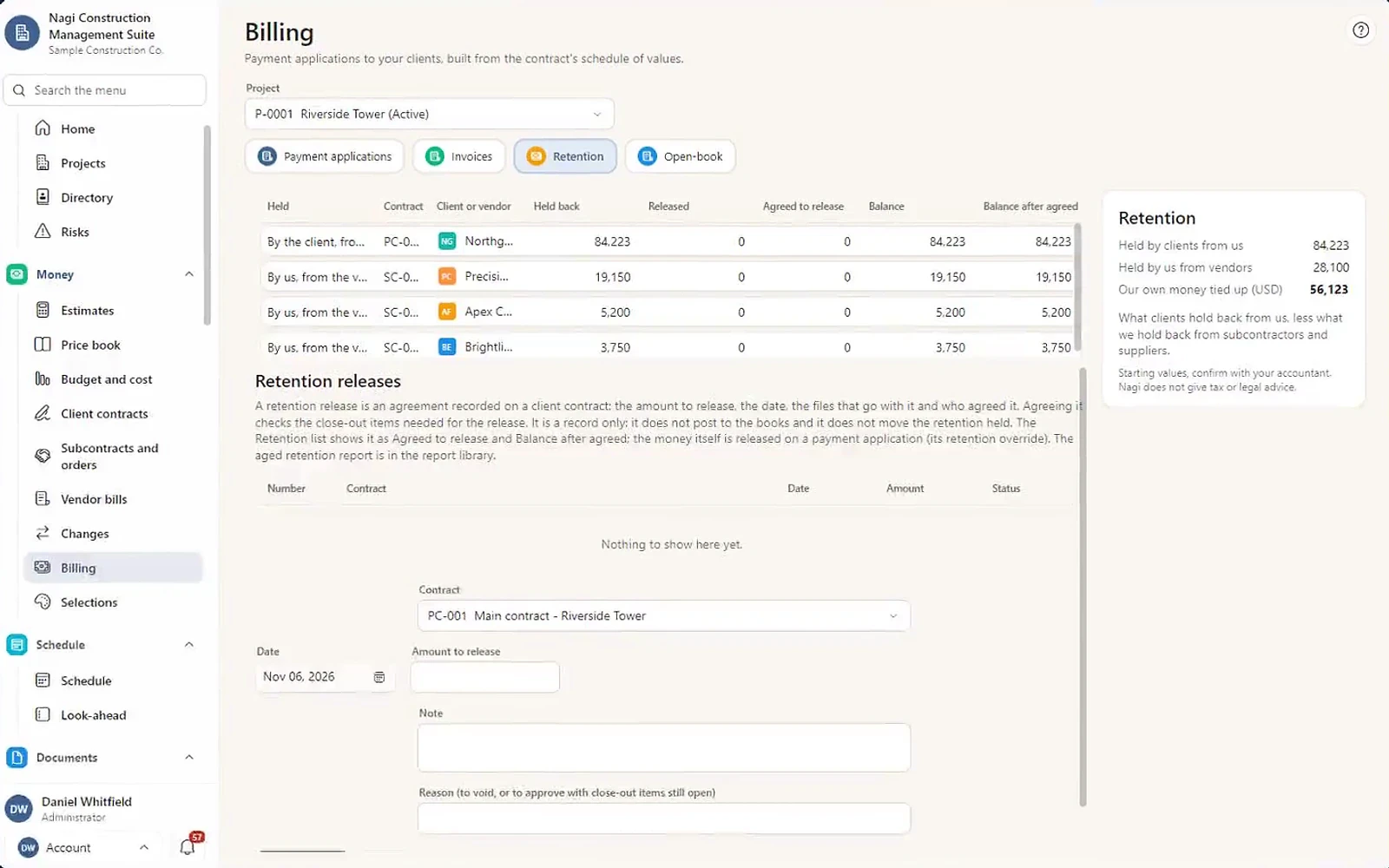
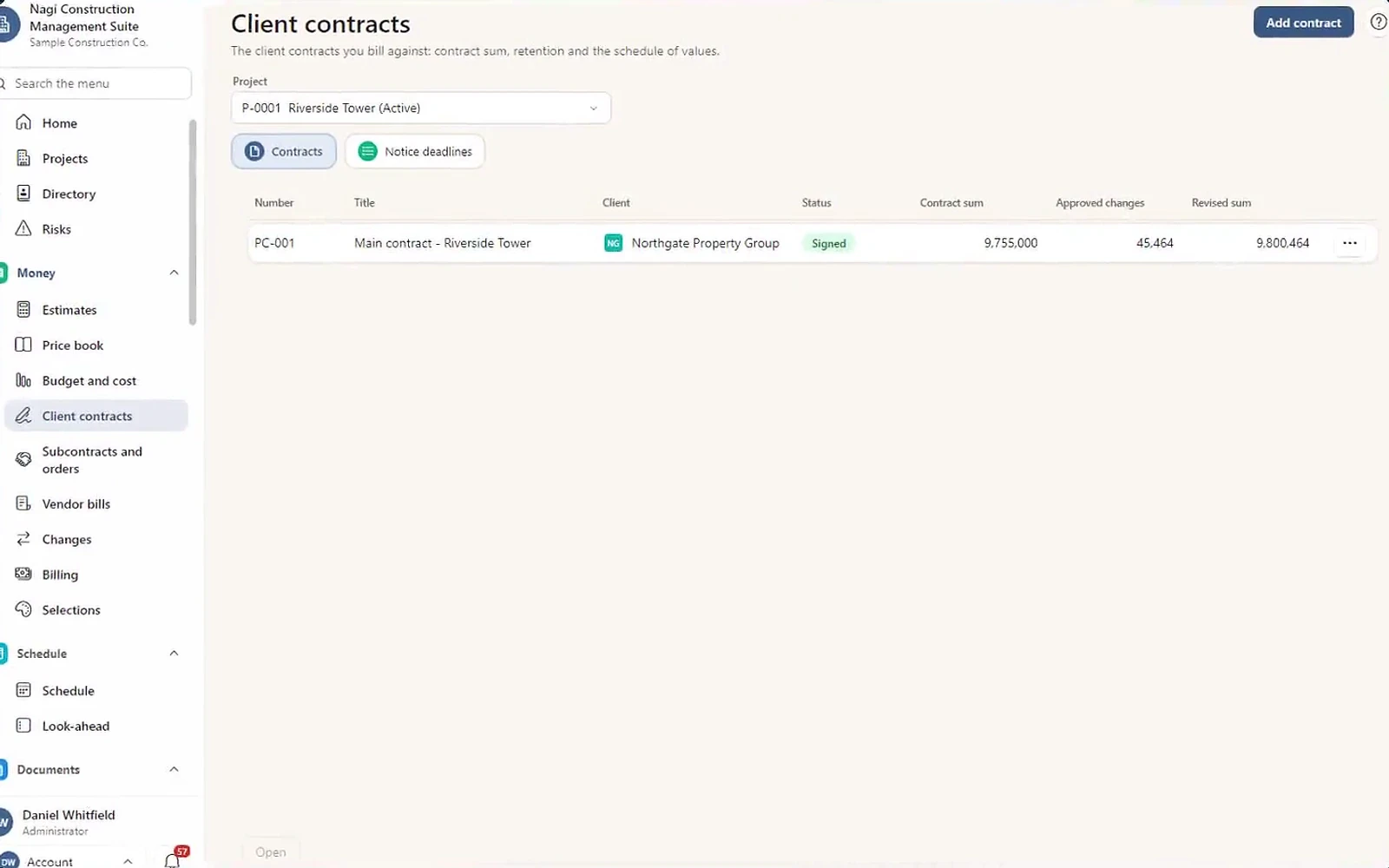
In Nagi Construction Management Suite (where the screens say "retention"), you set retention on the client contract, next to its schedule of values. The program builds each application for payment from the contract and the work done, so the retention held to date comes out of the same numbers every month instead of a separate tracker. What it covers, in the terms of this guide:
- Step-down. The contract has a "reduce at percent complete" point and a reduced rate, for example 10% down to 5% at 50% complete. Try your own clause on a test contract in the trial and check the result against readings A, B and C above.
- Stored materials. A separate retention rate can apply to stored materials, and it shows as its own amount on the application.
- Both sides of the chain. Subcontracts and purchase orders carry their own retention rate. Approving a sub's bill records the held amount as retention payable, and you pay it later on a retention release bill. Retention receivable and payable sit in separate accounts in the built-in books.
- Aging. An aged retention report lists receivable and payable per contract, by age, held and released, as PDF, CSV or a spreadsheet.
- Staged release. A release plan takes up to six stages, such as 50% at practical completion and 50% after the defects period, each with a due date or event. Before a release is approved, the program checks the job's close-out list, and any open item needs a typed reason to go ahead. The released amount is billed on the next application for payment.
Gulf contractors can run all of it in Arabic, right to left on screen and in printouts, in their own currency, with tax codes at their own rate and the company tax number on invoices. The program runs on your own PC, works offline apart from a few seconds online every 14 days, and you can test it on a real job in the browser trial. The monthly, yearly and lifetime prices are on the pricing page.
What it won't do: chase lien waivers for you, write legal release wording, or apply your state's retainage law automatically. You still set the rate and the stages the contract says.
Before your next contract, write down four things from the retainage clause: the rate, the step-down wording (A, B or C above), the release triggers, and the defects period. If any of them is missing, ask for it before you sign. Then put the release date in your calendar the day the job starts.
AIA, G702 and G703 are trademarks of The American Institute of Architects. FIDIC is a trademark of the International Federation of Consulting Engineers. Levelset is a trademark of its owner. Nagi Software is not affiliated with, endorsed by or sponsored by them.
Frequently asked questions
- How is retainage calculated?
Multiply the retainage rate by the work completed to date, plus stored materials if your contract holds retainage on them, then compare with what was already held. At 10%, $150,000 of work to date means $15,000 held in total; if $10,000 was held on earlier applications, this application holds another $5,000. Always work from the running total, not period by period.
- What is a typical retainage percentage?
In the US, 5% or 10% is most common, and many contracts drop from 10% to 5%, or stop withholding, once the job is half complete. State laws cap the rate on many public projects and some private ones. In the UK, retention is commonly around 5%; FIDIC-based contracts in the Gulf set their own rate and limit in the contract data.
- When is retainage released?
When the contract says so, usually in stages: part at substantial completion (practical completion in the UK, taking-over under FIDIC) and the rest after the punch list is finished, close-out documents are in and final lien waivers are signed. Outside the US, the second half often waits until the defects period ends, commonly 12 months later.
- Is retainage the same as retention?
Yes, it's the same holdback under two names. Retainage is the usual US term. Retention, or retention money, is used in the UK, Ireland, Australia, the Gulf and on FIDIC contracts. The calculation is identical; what differs is the typical rate, when it's released and the law around it.
- How do you record retainage in accounting?
The contractor who is owed it books retainage receivable, separate from ordinary receivables, when each application is billed. The party holding it books retainage payable, for example a general contractor holding a subcontractor's retainage. Both clear when the retainage is billed and paid at release. Your accountant decides how it's shown on the balance sheet.
- Can retainage be reduced during the project?
Often, if the contract or state law allows it. A common clause reduces retainage from 10% to 5%, or stops further withholding, once the work is 50% complete and on schedule. Read the wording closely: some reductions apply only to new work, others reset what was already held, and the difference on a mid-size job can be thousands of dollars.
Sources
- Levelset: retainage guide and state-by-state map, checked November 13, 2026
- GOV.UK: Late payment consultation, time to pay up (government response, updated 24 July 2026), checked November 13, 2026
- Kayrouz & Associates: retention and the final account in UAE construction (FIDIC Sub-Clause 14.9), 20 Oct 2026, checked November 13, 2026
- Nagi Construction Management Suite product page, checked November 13, 2026
The product in this post
Nagi Construction Management Suite
Run a construction company from estimate to close-out in one program that keeps your data on your own PC.
- retainage
- retention
- progress-billing
- construction-accounting
- pay-application