
Labor Burden Rate: How to Calculate It for Construction Job Costing
How to calculate a labor burden rate the right way, on one $32-an-hour carpenter: payroll taxes, workers' comp, insurance, benefits and paid time off, divided by the hours that actually reach a job. Free calculator included.
Nagi Software Team10 min read
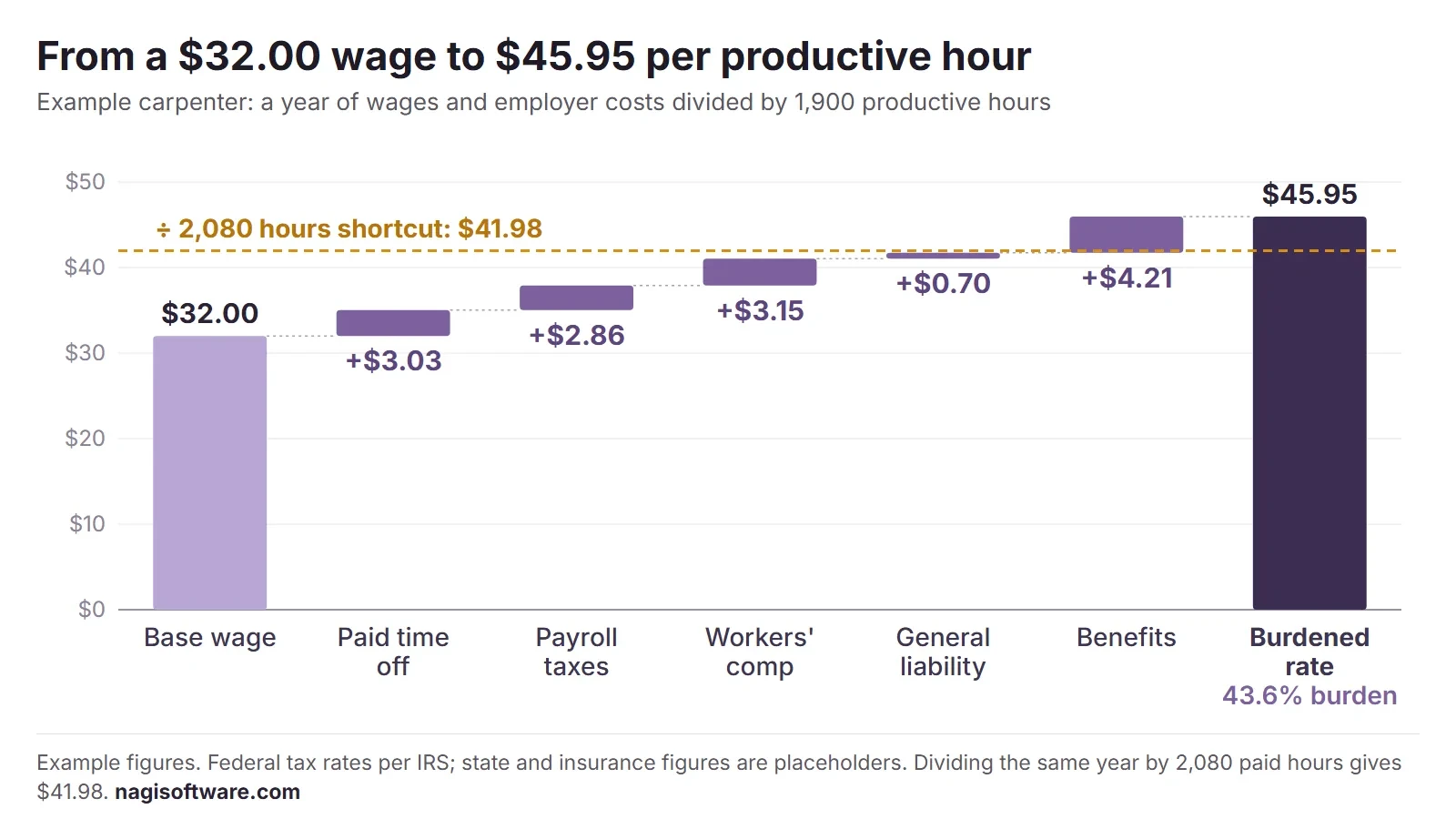
A labor burden rate is what an employee costs you beyond the base wage, as a percentage of that wage: employer payroll taxes, workers' comp, insurance, benefits and the paid hours that never reach a job. Divide the year's total cost by productive hours, not 2,080. Our example carpenter earns $32.00 an hour and costs $45.95, a 43.6% burden.
We build Nagi Construction Management Suite, which adds burden to every approved timesheet. Here is the same arithmetic by hand, so you can check any rate.
What labor burden includes
Labor burden is every cost that comes with a worker's pay but isn't the hourly wage for time on a job. Most of it is set by law or by your insurance policies; some of it you choose.
The usual parts, for a US contractor:
- employer Social Security and Medicare tax;
- federal and state unemployment tax (FUTA and SUTA);
- workers' compensation insurance, priced per $100 of payroll by class code;
- general liability insurance, if your policy is rated on payroll;
- health insurance and retirement contributions you pay;
- paid time off, holidays, paid training and shop time, because you pay those hours but can't charge them to a job;
- union fringe, if your crews are union.
What it leaves out is overhead. The office, the estimator's salary, the owner's truck and your software are company costs that no single worker causes. They go into your overhead rate and come back through markup. Mix them into burden and you'll charge them twice: once in the hourly rate, again in the markup. Our guide to markup vs margin shows how to set that overhead percentage.
The labor burden formula
Burdened hourly rate = (wages paid in a year + employer burden costs for the year) ÷ productive hours.
Burden percentage = burdened hourly rate ÷ base wage − 1.
The denominator decides whether the number is right. A full-time worker is paid about 2,080 hours a year (40 hours × 52 weeks). Only some of those hours land on a timesheet line with a job and a cost code. The rest is vacation, holidays, safety meetings and an hour loading the truck at the yard. You still pay for them, so the jobs have to carry them.
Many online calculators take burden as a percentage of wages and stop there. That spreads the cost over 2,080 hours and drops paid time off from the rate. It's the most common reason a burdened rate comes out a few dollars light.
How to calculate labor burden rate: a worked example
Example: one carpenter on your own crew, $32.00 an hour, full time, with family health cover and a 3% retirement match. The same inputs are pre-filled in the free calculator: download the labor burden calculator (.xlsx). No email needed. If you would rather work it out in the browser, the labor burden rate calculator shows what one worker really costs per productive hour, with every cost line shown.
Step 1: Count the paid hours
40 hours a week for 52 weeks is 2,080 paid hours, and $66,560.00 in wages at $32.00. Paid vacation and holidays are inside that figure. They're wages; they just aren't productive.
If your crews aren't paid for rain days, those days are neither paid nor billed, so leave them out of both numbers. Paid rain days go in the step 2 list.
Step 2: Take out the hours that never reach a job
| Paid but not on a job | Hours a year |
|---|---|
| Vacation (10 days) | 80 |
| Paid holidays (6 days) | 48 |
| Training and weekly toolbox talks | 24 |
| Shop, yard and unbilled travel time | 28 |
| Total | 180 |
| Productive hours (2,080 − 180) | 1,900 |
Pull these from last year's timesheets, not from memory. Shop time is the line owners underestimate most. One morning a week sorting material at the yard is 200 hours a year on its own.
Step 3: Add up the employer's costs for the year
| Cost | How it's worked out (Example) | Per year |
|---|---|---|
| Wages for the 180 hours off the job | 180 × $32.00 | $5,760.00 |
| Social Security and Medicare, employer share | 7.65% of $66,560 | $5,091.84 |
| Federal unemployment (FUTA) | 0.6% of the first $7,000 | $42.00 |
| State unemployment (SUTA) | your state's rate and wage base; 3.0% of $10,000 here | $300.00 |
| Workers' compensation | your class rate; $9.00 per $100 of payroll here | $5,990.40 |
| General liability charged on payroll | your policy rate; $2.00 per $100 here | $1,331.20 |
| Health insurance, employer share | your plan; $500 a month here | $6,000.00 |
| Retirement match | 3% of wages | $1,996.80 |
| Total burden | $26,512.24 |
The two federal tax lines come from the IRS. The employer pays 6.2% Social Security and 1.45% Medicare (IRS Topic 751); the Social Security part stops at a wage base of $184,500 for 2026, far above this carpenter's pay. FUTA is 6.0% of the first $7,000 of wages, cut to 0.6% for employers who get the full 5.4% state credit (IRS Topic 759). Everything below FUTA in the table changes by state, trade and policy, so type your own numbers into the yellow cells.
Workers' comp is the line that moves most between trades. Roofing, carpentry and office clerical work sit in different class codes, each with its own rate. That's why one company-wide burden rate is usually wrong for someone.
Step 4: Divide by productive hours
Divide each cost by 1,900 hours, then by the $32.00 wage, so every line becomes a percentage you can reuse.
| Component | Per productive hour | % of base wage |
|---|---|---|
| Base wage | $32.00 | |
| Paid time off the job | $3.03 | 9.47% |
| Payroll taxes (Social Security, Medicare, FUTA, SUTA) | $2.86 | 8.94% |
| Workers' compensation | $3.15 | 9.85% |
| General liability on payroll | $0.70 | 2.19% |
| Benefits (health, retirement) | $4.21 | 13.15% |
| Burdened rate | $45.95 | 43.60% |
Look at payroll taxes. As a share of the year's wages they're 8.16%, yet they come to 8.94% of the wage per productive hour. You pay tax on vacation pay too, and those hours bill nothing.
Step 5: Check it against the shortcuts
| Method | Hourly rate used | Burden |
|---|---|---|
| Bare wage | $32.00 | 0% |
| Year's cost ÷ 2,080 paid hours | $41.98 | 31.2% |
| Year's cost ÷ 1,900 productive hours | $45.95 | 43.6% |
The middle row is what you get from "burden as a percentage of wages". It isn't crazy. It just forgets that 180 paid hours have to be recovered from the other 1,900.
What the right rate does to a 400-hour job
Example: a framing package estimated at 400 hours of own-crew carpentry.
| Rate used in the estimate | 400 hours costs | Short by |
|---|---|---|
| $32.00 bare wage | $12,800 | $5,580 |
| $41.98 (2,080-hour method) | $16,792 | $1,588 |
| $45.95 (productive hours) | $18,380 | $0 |
Bid at the bare wage and $5,580 of real cost leaves the company with nothing in the price to cover it. Bid at $41.98 and the gap is $1,588 on one package. Across a year of jobs for one carpenter, it's 1,900 hours × $3.97, or about $7,540. Nobody notices it on any single job, which is why it survives for years.
The same rate belongs in change orders. A change priced at the bare wage loses money on every hour of extra work; our guide on how to price change orders carries the burdened rate through a full change-order build-up.
Mistakes that make the burden rate wrong
Most bad burden rates come from five habits. Each is easy to fix once you know where to look.
Dividing by 2,080 hours
Covered above. Of everything on this page, the denominator is the one to get right.
Ignoring wage-base caps
FUTA and many state unemployment taxes stop once a worker passes the wage base, often early in the year. Payroll cost per hour is higher in January than in October. Use the annual total in the rate, as the calculator does, so January jobs aren't priced higher than autumn ones.
One rate for every trade
Workers' comp class rates, union fringe and benefits differ by role. Give each trade, or each worker, its own burdened rate. The calculator's "Crew rates" tab holds up to 15 workers side by side.
Putting the full percentage on overtime premium
Health insurance and the FUTA cap don't grow when someone works Saturday; payroll taxes and, depending on your state and policy, parts of workers' comp do. On a crew with a lot of overtime, ask your payroll provider which costs scale with the premium hours and apply only those. For a crew with little overtime, the difference is small.
Never updating it
Rates change on fixed dates: wage bases on 1 January, workers' comp and liability at renewal, health premiums at plan renewal, wages at each raise. Recalculate on each of those dates. A rate set three years ago is a guess.
What a typical labor burden percentage looks like
Published ranges are wide. SmartBarrel's guide says burden in construction typically adds 35% to 60% on top of the hourly rate (SmartBarrel). Our example sits at 43.6%, inside that band, mostly because of family health cover and a carpentry comp rate.
Don't borrow anyone's range for a bid. A laborer on a low wage with family health cover runs a higher percentage than our carpenter, because the premium is a fixed dollar amount spread over a smaller wage. A well-paid foreman who declines benefits runs lower. Union crews add fringe on top, often set per hour in the agreement. The calculator gives you your own number in about ten minutes once you have last year's payroll summary and your insurance declarations page.
The free labor burden calculator
The workbook has four tabs. "How to use" comes first. "Calculator" is the worked example above, with every input shaded yellow: wage, paid hours, the hours off the job, each tax rate and its wage base, workers' comp and liability per $100, and benefits. "Crew rates" repeats the method for up to 15 workers in rows. "Job impact" takes estimated hours and shows the bare, 2,080-hour and productive-hour cost side by side, like the 400-hour table.
Formula cells are locked without a password, so you can unprotect the sheet if you want to change the method. Nothing in it is gated.
Use the burdened rate in three places: every estimate line with own-crew hours (our construction estimate template has a cell for it), the labor lines of your job budget (see the construction budget template), and change-order pricing. Code the hours to the same cost codes every time; our starter list of cost codes splits labor from material on each code for exactly this reason. Once you have the rate, the labor hours and productivity calculator works out hours, crew days and cost from a quantity and your own output rate, and the rest of our calculators are on the free tools page.
How Nagi Construction Management Suite applies burden
A spreadsheet gives you the rate. Applying it to every timesheet, week after week, is where it usually slips. In Nagi's job costing the rate goes on the worker and the burden goes on a profile, and approved timesheets do the rest:
- Each worker has an hourly rate, effective-dated, so a raise on 1 March doesn't rewrite February's cost. Overtime is costed at the worker's overtime multiplier.
- A burden profile is a list of percentage components you enter, such as payroll tax, workers' comp, benefits or union fringe. One profile is the company default; any worker can have their own instead. For our carpenter you'd enter the five percentages from step 4, totaling 43.6%, rather than the 31.2% you'd get from the 2,080-hour shortcut.
- When a timesheet of your own crew is approved, its hours are costed at wages plus burden and posted to the job by the timesheet's cost code and cost type. The same entry posts to the books: labor cost on one side, accrued wages on the other.
- A timesheet is costed whole or not at all. If a worker has no rate or no profile, it lands on a "not costed" list with the reason, and you cost it once the gap is fixed. Reopening an approved timesheet reverses its cost.
Job cost rows show hours and money by code, never the worker's name, so a site manager reading the cost report doesn't see anyone's pay.
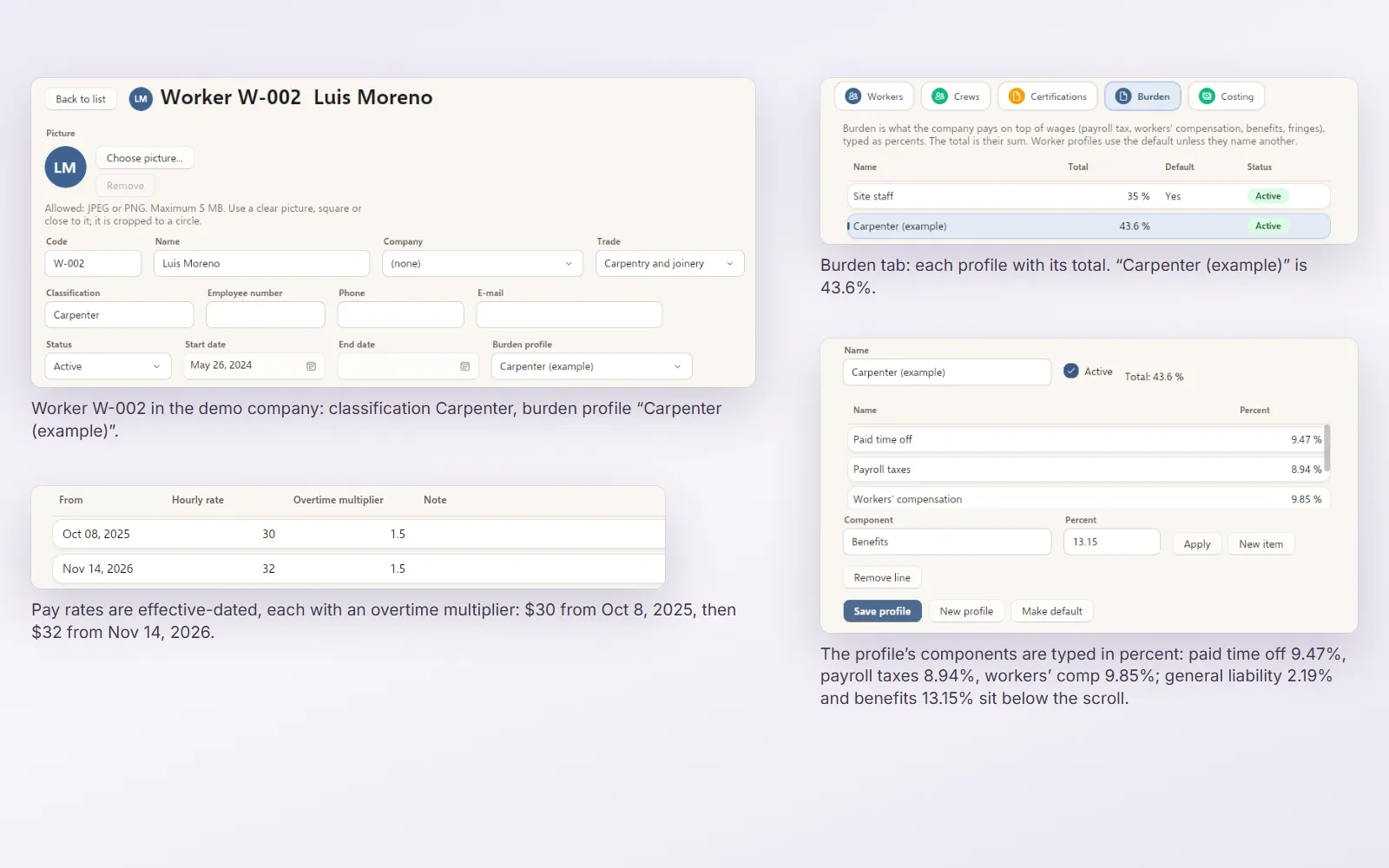
What it doesn't do: there's no payroll. Paying people, withholding and filing payroll taxes stay with your payroll provider. No statutory rates come built in; you type the percentages, which is why the calculator exists. Subcontractor crews aren't costed from timesheets at all: their cost comes in through subcontracts and vendor bills.
Which way to run it
If you have one or two crews and bid a handful of jobs a year, the calculator is enough. Work out each person's rate every January and at insurance renewal, paste the rates into your estimate template, and review your labor cost codes weekly.
Costing several crews every week is different: the rate has to reach every approved timesheet without anyone retyping it, or the job cost report drifts back toward bare wages. That's the job the burden profile does. Enter one real worker with this year's numbers, approve one week of their timesheets in the trial, and compare the cost posted to the job with the calculator's answer. The monthly, yearly and lifetime prices are on the pricing page.
More on the same numbers: the full cost-code example in our job costing guide.
Frequently asked questions
- What is a labor burden rate?
A labor burden rate is the cost of an employee beyond the base wage, shown as a percentage of that wage. It covers employer payroll taxes, workers' compensation, insurance charged on payroll, benefits and paid hours that never reach a job. Our example carpenter earns $32.00 an hour and costs $45.95 per productive hour, a 43.6% burden.
- How do you calculate labor burden?
Add up a year of wages and every employer cost tied to the worker, then divide by the hours they actually work on jobs, not the 2,080 hours you pay. That gives the burdened hourly rate. Divide it by the base wage and subtract one to get the burden percentage. Our free calculator does the arithmetic per worker.
- What is a typical labor burden percentage in construction?
There is no standard figure, because workers' comp class rates, state unemployment tax and benefits differ by company and state. SmartBarrel's guide puts construction burden at 35% to 60% on top of the hourly rate. Our worked example lands at 43.6%. Work out your own from your payroll provider's and insurer's numbers rather than borrowing a range.
- Should labor burden be divided by 2,080 hours?
No. You pay roughly 2,080 hours a year, but vacation, holidays, training and shop time never reach a job. Divide by productive hours instead. In our example, 1,900 productive hours give $45.95 an hour; dividing the same cost by 2,080 gives $41.98, which underprices every hour you bid by $3.97.
- Is labor burden the same as overhead?
No. Labor burden is tied to a specific worker's pay: taxes, workers' comp, benefits and paid time off. Overhead is the cost of running the company that no single worker or job causes, such as the office, the estimator and company trucks. Put burden in the hourly rate you charge to jobs and recover overhead through your markup.
Sources
- IRS Topic 751: Social Security and Medicare withholding rates, checked November 14, 2026
- IRS Topic 759: Form 940, Employer's Annual Federal Unemployment (FUTA) Tax Return, checked November 14, 2026
- SmartBarrel: Understanding the hidden costs of labor burden in construction, checked November 14, 2026
- Nagi Construction Management Suite job costing page, checked November 14, 2026
The product in this post
Nagi Construction Management Suite
Run a construction company from estimate to close-out in one program that keeps your data on your own PC.
- labor-burden
- job-costing
- estimating
- construction-accounting
- small-contractors