
Performance Review Template for Small Businesses (With a Scoring Sheet)
A free performance review template for 10 to 50 person businesses: five weighted criteria, a 1 to 5 scale with behavior anchors, a scoring sheet that works out the rating band, a filled example and a 45-minute meeting plan.
Nagi Software Team9 min read
A performance review template is a form a manager fills in once or twice a year: a few criteria, a score for each, evidence for every score, goals for the next period and both signatures. Ours is built for businesses of 10 to 50 people, with five weighted criteria, a 1 to 5 scale where every number has a written meaning, and a scoring sheet that works out the result.
We make Nagi HR Suite, whose review module scores against weighted criteria and computes a rating band. The template uses the same method, so you can start on paper and move later without changing how people are rated.
Download the performance review template (Excel)
The workbook is free with no email form and opens in Google Sheets. It has the scale and criteria you can edit, a printable one-page review form, a notes log for the year, and a team sheet that ranks scores side by side. Type in the white cells; the gray ones calculate.
Download the performance review template (.xlsx)
| Sheet | What it holds |
|---|---|
| How to use | Setup and the 45-minute meeting plan |
| Criteria and scale | Five criteria with weights, the 1 to 5 scale, behavior anchors, rating bands |
| Review form | One employee, one period: scores, evidence, strengths, goals, comments, signatures |
| Notes log | Dated notes per employee through the year |
| Team scores | One row per employee: five scores, weighted score, band |
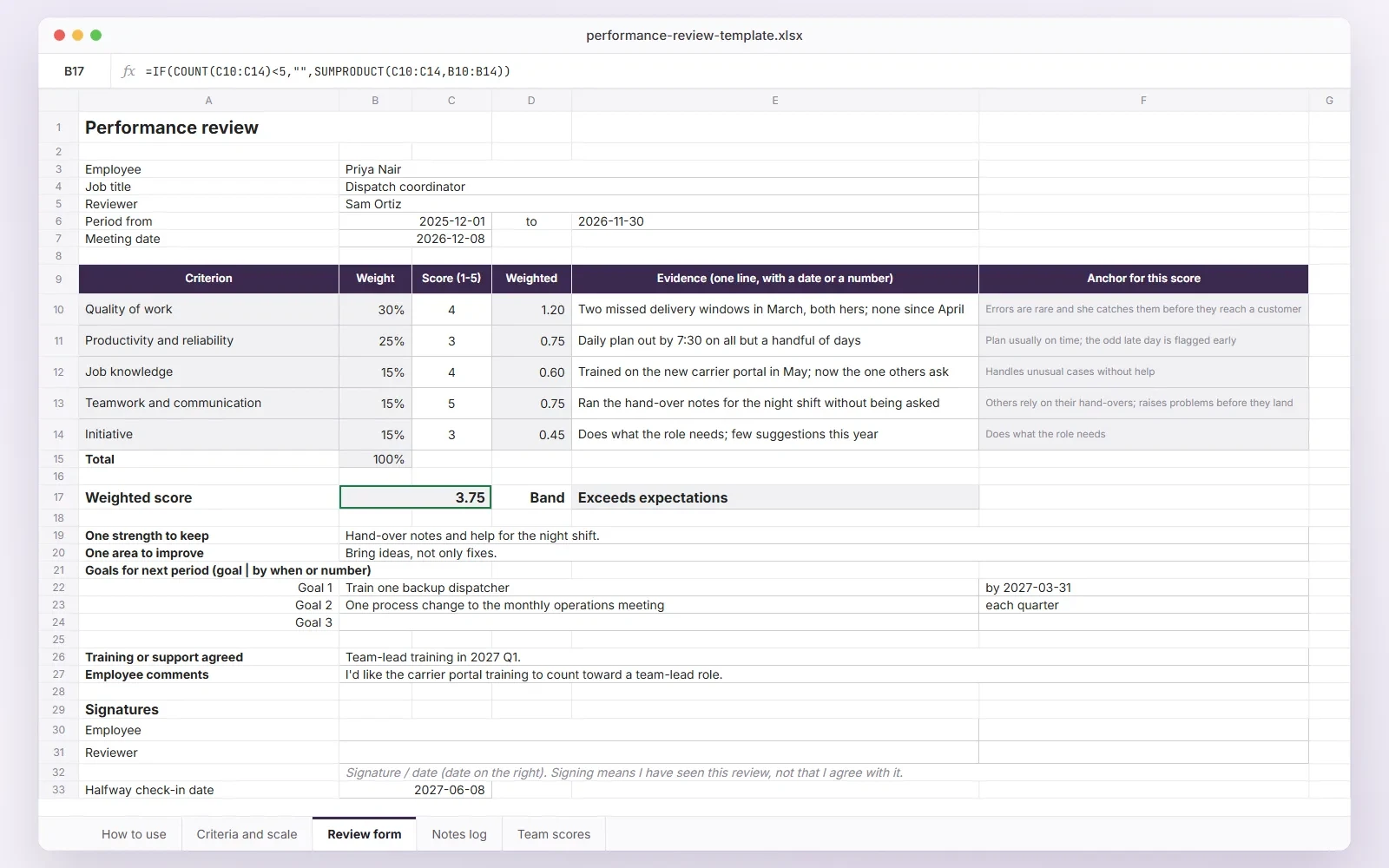
What a small-business review includes
A review a small business will actually finish fits on one page. It needs the names and period, five criteria, a score and evidence for each, one strength, one thing to improve, two or three goals, the employee's comments and two signatures. Anything longer tends to get skipped by March.
Big-company forms run to 30 competencies and a self-assessment essay. That's fine with an HR department. With a manager who also runs a warehouse shift, the form doesn't get done, and a review that never happens helps nobody.
The parts of our form, top to bottom:
- Employee, job title, reviewer, review period, meeting date
- Five criteria with weight, score (1 to 5) and one line of evidence each
- Weighted score and rating band (calculated)
- One strength to keep, one area to improve
- Goals for the next period, each with a date or a number
- Training or support agreed
- Employee comments, in their own words
- Signatures and dates for both, with "signing means I've seen this review, not that I agree with it"
The last line saves arguments. People sign more readily when the form says plainly that a signature is an acknowledgment.
Five criteria and their weights
Five criteria cover most small-business roles: quality of work, productivity and reliability, job knowledge, teamwork and communication, and initiative. Weight them by what the job is for. A dispatcher's errors cost more than a slow day, so quality carries the most weight in our example.
| Criterion | What it covers | Weight (example) |
|---|---|---|
| Quality of work | Accuracy, rework, customer complaints | 30% |
| Productivity and reliability | Output, deadlines, attendance, follow-through | 25% |
| Job knowledge | Knows the systems, rules and products of the role | 15% |
| Teamwork and communication | Hand-overs, helping others, raising problems early | 15% |
| Initiative | Fixes things without being asked, suggests improvements | 15% |
Change the names and weights per role in the Criteria and scale sheet. The weights have to add up to 100%; the sheet shows a red warning if they don't.
A 1 to 5 scale with behavior anchors
A rating scale only works when each number means the same thing to every manager. Write one sentence per score describing what you'd see, called a behavior anchor, and score against the sentence, not against a feeling. Then a 4 from one manager is a 4 from another.
The general scale:
| Score | Label | What it looks like |
|---|---|---|
| 5 | Outstanding | Well beyond the role, every month; others learn from them |
| 4 | Exceeds | Regularly above the standard; needs little checking |
| 3 | Meets | Does the job to the standard set; the odd miss is fixed quickly |
| 2 | Needs improvement | Misses often enough that someone checks or redoes the work |
| 1 | Unsatisfactory | Below standard most of the time, already discussed without change |
Each criterion then gets its own anchors in the job's language. Here is quality of work for a dispatcher:
| Score | Quality of work, dispatcher |
|---|---|
| 5 | Routes and paperwork right first time; catches other people's errors before trucks leave |
| 4 | Errors are rare and she catches them before they reach a customer |
| 3 | Occasional errors, caught at the normal check, fixed the same day |
| 2 | Errors reach customers about once a month; work needs a second check |
| 1 | Errors every week; work regularly has to be redone |
A 3 is a good score. Say so in the meeting, because many people hear "3 out of 5" as 60%.
Worked example: a filled review
Example: Priya Nair, dispatch coordinator at Kestrel Logistics (our demo company), reviewed by Sam Ortiz, operations manager, for 1 December 2025 to 30 November 2026.
| Criterion | Weight | Score | Weighted | Evidence |
|---|---|---|---|---|
| Quality of work | 30% | 4 | 1.20 | Two missed delivery windows in March, both hers; none since April |
| Productivity and reliability | 25% | 3 | 0.75 | Daily plan out by 7:30 on all but a handful of days |
| Job knowledge | 15% | 4 | 0.60 | Trained on the new carrier portal in May; now the one others ask |
| Teamwork and communication | 15% | 5 | 0.75 | Ran the hand-over notes for the night shift without being asked |
| Initiative | 15% | 3 | 0.45 | Does what the role needs; few suggestions this year |
| Total | 100% | 3.75 |
The bands in the template are equal steps of 0.8 points:
| Weighted score | Band |
|---|---|
| 1.00 to 1.79 | Unsatisfactory |
| 1.80 to 2.59 | Needs improvement |
| 2.60 to 3.39 | Meets expectations |
| 3.40 to 4.19 | Exceeds expectations |
| 4.20 to 5.00 | Outstanding |
Priya's 3.75 lands in Exceeds expectations. Her goals for next year: train one backup dispatcher by 31 March, and bring one process change to the monthly operations meeting each quarter. Her comment: she wants the carrier portal training to count toward a team-lead role.
Weights change results. Lena Fischer, on the team sheet, scores 2, 4, 5, 5 and 5. A plain average says 4.2, which would be Outstanding. Weighted, her low quality score counts for 30% and she gets 3.85, Exceeds. For a role where quality is the job, the weighted figure is the honest one.
The formula behind it is short:
Weighted score =SUMPRODUCT(Scores, Weights)
Band           =LOOKUP(Weighted, {1, 1.8, 2.6, 3.4, 4.2}, {"Unsatisfactory", "Needs improvement", "Meets expectations", "Exceeds expectations", "Outstanding"})
How to run the review in 45 minutes
Fill in the form before the meeting and share it a day early, so the meeting is a conversation and not a reading. Then spend 45 minutes on five parts: the employee's view, the scores, goals, support, and sign-off.
- Their view (10 minutes). Ask what went well this year and what got in the way. Listen first.
- The scores (15 minutes). Go criterion by criterion. Read the evidence, not just the number.
- Goals (10 minutes). Agree two or three, each with a date or a number.
- Support (5 minutes). Training, tools, or a change in how work reaches them.
- Sign-off (5 minutes). They write their comments, both sign, and you agree the date of the halfway check-in.
If the meeting turns into an argument about one score, note the disagreement in the comments and move on. You can change a score after the meeting if they bring evidence you missed.
Keeping it fair: the notes log
The biggest fairness problem in small-business reviews is recency: the score reflects the last month, not the year. Fix it with two lines per person per month in the Notes log, written when something happens, good or bad. At review time, filter the log by name and the evidence is already there.
Priya's March notes would read: "4 Mar, missed window for the Harbor Foods delivery, route sent late" and "19 Mar, missed window, carrier change not updated". In December nobody remembers those dates. The log does.
Two more checks help. Score every criterion before you look at the total, so you don't work backwards from the band you've already decided on. And compare your team's scores side by side on the Team scores sheet: if everyone is a 4, the scale has stopped meaning anything. To see who sits where once the scores are in, the free 9-box grid builder places people from their performance and potential ratings, and more of our HR builders are on the free tools page.
A spoken version for crews
Self-review essays don't suit warehouse, site or driving crews, and most templates offer nothing else. For crews, keep the same five scores but run the review standing up, in 15 minutes, with the manager writing.
Ask three questions and write the answers in the comments box: what went well, what got in the way, and what one thing would make the job easier. Score the five criteria with them, read the band out, agree one goal, and both sign. If the goal is a skill gap, the free skills matrix builder rates people against a target level and shows who can cover for whom. The paperwork is the same as everyone else's, so scores still compare across the company.
Linking reviews to pay and to warnings
A review gets taken seriously when everyone knows what a band means for pay, and that guide is written before the reviews start. Separately, a review is never the place where someone first hears about a serious problem.
An example raise guide, which your budget decides, not this post:
| Band | Raise range (example) |
|---|---|
| Outstanding | 4% to 5% |
| Exceeds expectations | 3% to 4% |
| Meets expectations | 2% to 3% |
| Needs improvement | None until the improvement plan is met |
| Unsatisfactory | None; improvement plan or next steps |
Warnings follow their own process, with dates and the employee's acknowledgment at the time it happens. If Omar had a written warning in June, the review mentions it as evidence, but the warning itself was already documented then. Our employee write-up form covers that process, and every signed review belongs in the employee's file (see the personnel file checklist). For new hires, use the shorter probation review template at the end of probation.
Performance reviews in Nagi HR Suite
Nagi HR Suite runs the same method in software. A review moves from draft to complete to employee acknowledgment, it scores against criteria and weights you configure, and it computes the rating band for you.
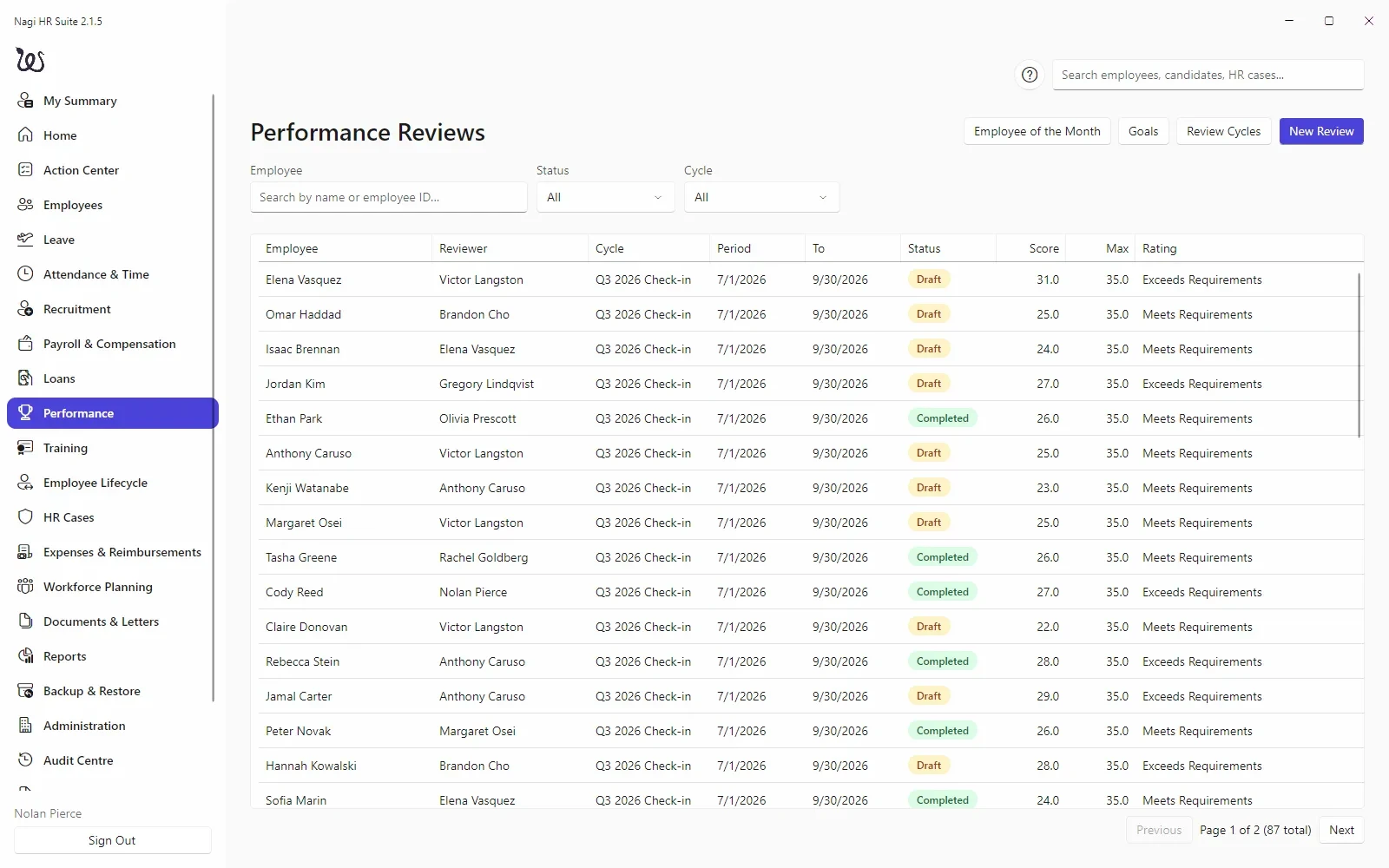
Around the review, the app keeps performance goals, Employee of the Month (one per calendar month, enforced), a training log and certifications with an expiring-soon view. Probation, confirmation, promotion and transfer are lifecycle events that change the employee's status, assignment or pay, and they all show on one timeline per employee. Warning and promotion letters come from templates you edit, with fields filled from the employee record.
When the review leads to a raise, you give it as a percentage or an amount from any date, for one person or as an annual increment for everyone. Once approved, anything already paid at the old rate is worked out as arrears in the next payroll run, and nobody records or approves their own pay. Payroll uses your own rules: it applies no tax rules and files nothing, so your accountant keeps doing that.
The product page doesn't list 360-degree feedback, peer surveys or continuous feedback tools. If you need those, a dedicated performance platform does more than we do.
The data stays on your own Administrator PC unless you choose Nagi Cloud. One company license covers the Administrator PC, 10 employee PCs and 11 phone connections, with unlimited employee records: $19 a month, $190 a year or $349 once, as listed on our pricing page on 14 November 2026.
Use the spreadsheet if one person reviews fewer than about 15 people once a year. Move to software when several managers review, when reviews need to drive raises and letters without retyping, or when you want every review and warning on one timeline. You can try that with your own criteria on the Nagi HR Suite page or in the trial.
Frequently asked questions
- What should be in a performance review template?
The employee and reviewer names, the review period, a short list of weighted criteria, a rating scale with a description for each score, evidence for each rating, strengths, areas to improve, goals for the next period, the employee's own comments and both signatures. Five criteria are enough for most small-business roles.
- How do you calculate a weighted performance score?
Multiply each criterion's score by its weight and add the results. With weights of 30, 25, 15, 15 and 15 percent and scores of 4, 3, 4, 5 and 3, the weighted score is 1.20 + 0.75 + 0.60 + 0.75 + 0.45 = 3.75. Then read the band from your scale: here, Exceeds expectations.
- What should I write in a performance review?
Write what the person did, with a date or a number, then what you want next. 'Two delivery windows missed in March, none since' beats 'needs to be more careful'. Give each rating one or two pieces of evidence, name one strength to keep and one thing to change, and agree two or three goals.
- How often should a small business do performance reviews?
Once a year is the minimum most small businesses manage, with a short check-in halfway through. New hires also get a review at the end of probation. What makes any schedule work is keeping notes during the year, so the review doesn't rest on the last few weeks.
- Should a performance review be linked to pay raises?
It helps if the link is written down before the reviews start, so nobody argues the score to win the raise. A simple guide maps each rating band to a raise range within your budget. Keep warnings separate: nobody should hear about a serious problem for the first time in their annual review.
Sources
- Nagi HR Suite product page (performance reviews, goals, increments), checked November 14, 2026
The product in this post
Nagi HR Suite
HR, attendance, leave and payroll in one desktop application.
- performance-review-template
- employee-evaluation-form
- performance-appraisal
- excel-template
- small-business