
Employee Write-Up Form: Free Template and How to Document a Warning
A free employee write-up form in Word, a filled example for repeated lateness, a warning ladder with timelines, how to deliver it, and what US, UK and Australian rules expect before a warning leads anywhere.
Nagi Software Team9 min read
An employee write-up form is the written record of a warning: what happened, which rule it broke, what must change by when, and what follows if it doesn't, signed by the manager and the employee. Our free Word form has those fields, a filled example for repeated lateness, and a final-warning version.
We make Nagi HR Suite, which keeps warning letters and attendance on each employee's record, so this guide is about the paper trail that holds up later. If it isn't on record, it didn't happen.
Download the write-up form (Word)
The download is one Word file with four pages: the blank write-up form, the filled lateness example from this post, a final written warning version, and a verbal warning note with the warning ladder. Fields sit in [square brackets]. No email needed.
Download the employee write-up form (.docx)
Print it or fill it on screen. Either way, the signed copy goes in the employee's file the same day.
When to write someone up
Write it up when a conversation has already happened and the problem came back, or when one incident is serious enough to need a record straight away. A first small slip usually gets a quiet word, with a dated note in your own file.
Three situations nearly always call for a write-up. A pattern: the third late arrival in a month, not the first. A clear breach of a written rule, like skipping a safety step. Or a conversation the employee later says never happened. If your only record of the first warning is "I told him in the yard," you can't show it.
Don't write someone up for things you've never told them about. If the rule isn't in the handbook or a previous note, the first step is to tell them the rule.
What goes on a write-up form
A useful write-up has nine fields. Each one answers a question someone will ask months later, maybe at a hearing, maybe at an unemployment claim.
| Field | What to write | The question it answers |
|---|---|---|
| Employee details | Name, ID, job title, manager | Who? |
| Date and type | Date issued; verbal note, written, or final written | Which step is this? |
| What happened | Dates, times, places, facts you or a record can show | What exactly did they do? |
| Rule or policy | The handbook section or instruction | Did they know the rule? |
| Earlier steps | Dates of previous conversations or warnings | Were they warned before? |
| Expected change | The specific behavior, from when, for how long | What does "fixed" look like? |
| Consequence | What happens if it happens again | Did they know what was at stake? |
| Employee comments | Their account, in their words, or "none" | Were they heard? |
| Signatures | Manager, employee, witness if they decline, dates | Did they receive it? |
Write facts, not character. "Arrived at 7:35 for a 7:00 start on 13 October" is a fact. "Doesn't take the job seriously" is an opinion, and it gives the employee something to argue with instead of something to fix.
Filled example: repeated lateness
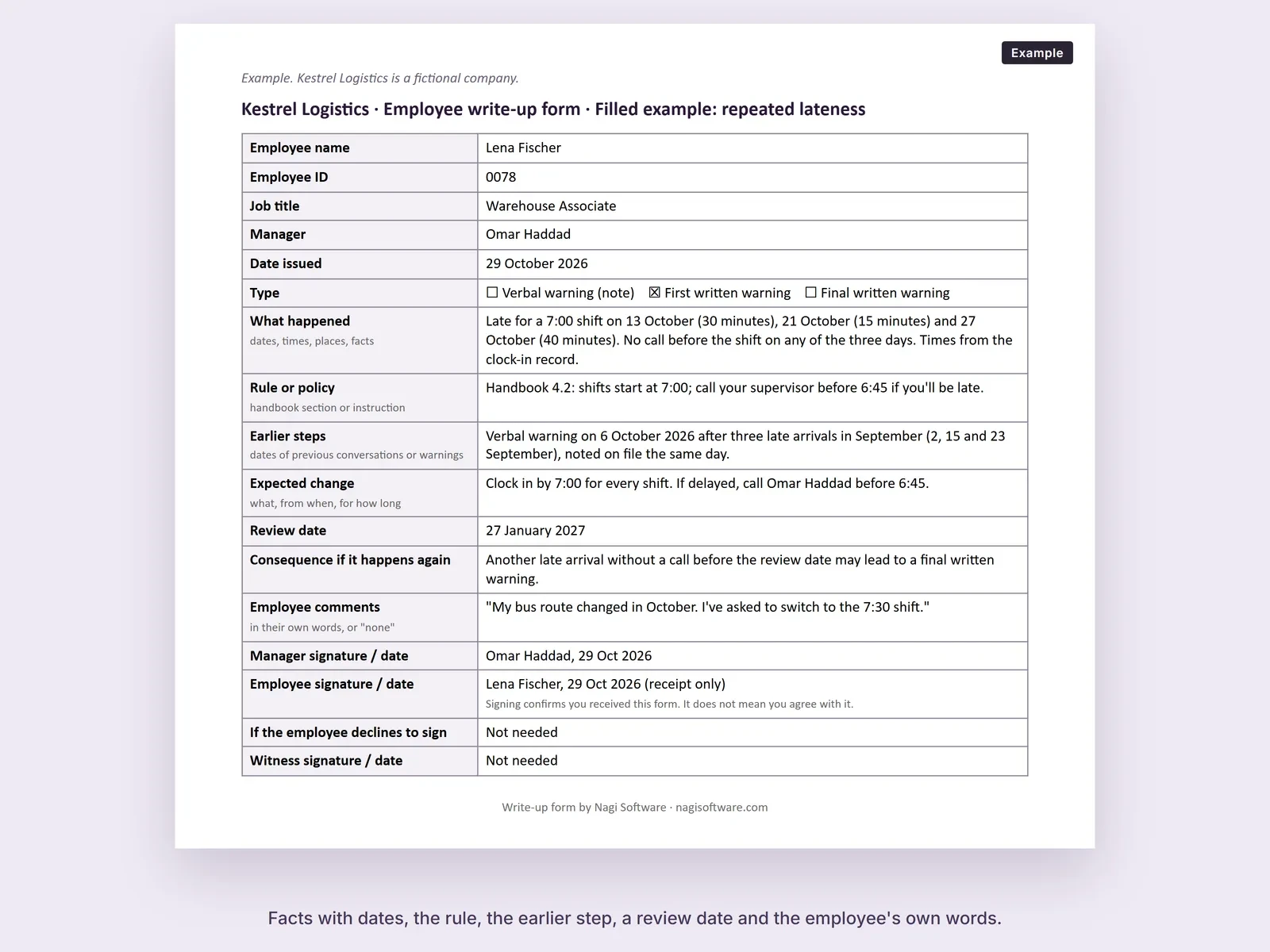
Here is the form filled in for a case almost every small employer meets sooner or later: lateness. The company is our fictional Kestrel Logistics.
| Field | Entry |
|---|---|
| Employee | Lena Fischer, ID 0078, Warehouse Associate; manager Omar Haddad |
| Date and type | 29 October 2026; first written warning |
| What happened | Late for a 7:00 shift on 13 October (30 minutes), 21 October (15 minutes) and 27 October (40 minutes). No call before the shift on any of the three days. Times from the clock-in record. |
| Rule | Handbook 4.2: shifts start at 7:00; call your supervisor before 6:45 if you'll be late. |
| Earlier steps | Verbal warning on 6 October 2026 after three late arrivals in September (2, 15 and 23 September), noted on file the same day. |
| Expected change | Clock in by 7:00 for every shift. If delayed, call Omar Haddad before 6:45. Review on 27 January 2027. |
| Consequence | Another late arrival without a call before the review date may lead to a final written warning. |
| Employee comments | "My bus route changed in October. I've asked to switch to the 7:30 shift." |
| Signatures | Omar Haddad, 29 Oct 2026; Lena Fischer, 29 Oct 2026 (receipt only) |
Look at the employee comment. It gives you a fix that may be cheaper than a final warning: a later shift. A write-up that leaves room for the employee's account often ends the problem at this step. When a written warning is still the right step, the free written warning letter generator writes a first, second or final warning from the facts, and more of our HR builders are on the free tools page.
What to write for a verbal warning
A verbal warning is spoken, but it still needs a note. Two or three lines are enough: the date, what you discussed, what you asked for, and that you told the employee a written warning would follow if it happened again.
Keep the note in the employee's file, not in your phone. The written warning will list it under earlier steps, and without the note that line is your word against theirs. Some employers ask the employee to initial the note. That's optional; a dated note written the same day is what counts.
The warning ladder, with timelines
Most small businesses use four steps, and the steps are company policy, not law. Write your own version in the handbook and apply it the same way to everyone.
| Step | What it is | Typical time it stays current |
|---|---|---|
| 1. Verbal warning | A private conversation, noted on file with the date | 6 months |
| 2. First written warning | The write-up form, signed | 6 to 12 months |
| 3. Final written warning | The form marked "final", stating that dismissal is the next step | 12 months |
| 4. Dismissal or other action | Decided after a meeting, with the record in front of you | n/a |
Serious misconduct, such as theft or violence, can skip steps. Your handbook should say so in plain words. Expired warnings stay in the file, marked as expired, so you can show the history.
What US, UK and Australian rules expect
The form works in all three countries, but the process around it differs. These are the points we could confirm on each official site.
In the US, employment is at will in every state except Montana: either side can end it at any time, but "the reason for termination cannot be illegal" (USA.gov). A write-up doesn't change at-will status. It's your record that the real reason was the lateness, and that you treated this employee the way you treat others.
In the UK, the Acas Code of Practice sets the expected process. Investigate without unreasonable delay. Tell the employee in writing what the case is before the meeting. Workers have a statutory right to be accompanied at a disciplinary meeting that could lead to a warning. Tell them how long the warning will remain current, and let them appeal, ideally to a manager who wasn't involved. A tribunal can adjust an award by up to 25% if the Code wasn't followed. For UK use, add "right to be accompanied" and "appeal to" lines to the form; the download has them.
In Australia, small businesses with fewer than 15 employees can follow the Small Business Fair Dismissal Code. Before a dismissal that isn't for serious misconduct, the employee must be warned that their job is at risk, given a valid reason, a chance to respond and a reasonable chance to fix the problem. The consequence line on our form, and the employee comments box, are where you show both.
How to deliver a written warning
Delivering the warning takes about 15 minutes. Prepare for longer than that. Follow these steps so the meeting matches the paper.
- Gather the facts first: clock records, emails, the earlier note. Fill in everything except the employee comments.
- Book a private meeting the same week as the latest incident. A warning about something from two months ago looks like a pile-up, not a response.
- In the UK, tell the employee in writing beforehand and offer a companion. Elsewhere, consider having a second manager present.
- Read the facts, the rule and the expected change. Then stop and ask for their side.
- Write their comments in their words, or let them write them.
- Ask them to sign for receipt. If they decline, write "Employee declined to sign" with the date and time, and have the second manager sign that note.
- Give them a copy, file the original the same day, and put the review date in your calendar.
Step 7 is the one that gets skipped. Nobody reviews on the date, the employee hears nothing, and three months later the next incident starts from zero because the manager who issued the first warning has moved to another site and the form is in a folder only they knew about. Calendar it.
Mistakes that make a write-up useless
The common failures are small and avoidable. Each one gives the employee, or a tribunal, a reason to discount the record.
- No dates or times, only "often late".
- Opinions in place of facts ("bad attitude", "lazy").
- No earlier steps listed, so it looks like a first warning every time.
- No consequence line, so nobody can say they knew what was at stake.
- Treating one employee more harshly than another for the same thing.
- A form that's signed but never filed, or filed in a manager's desk drawer.
Keeping warnings on the employee record
A paper form in a drawer is hard to find when you need it. Warnings need to sit with the rest of the person's file, and the facts behind them should come from a record nobody typed after the fact.
In Nagi HR Suite, the warning letter is one of the templates in the letter template engine, next to offer, confirmation, experience and termination letters. You edit the wording once; merge fields are filled from the employee record when you generate it. The signed copy goes on the record as a document attachment. Lifecycle events such as probation, confirmation, promotion and separation sit on one timeline per employee, with a real effect on status.
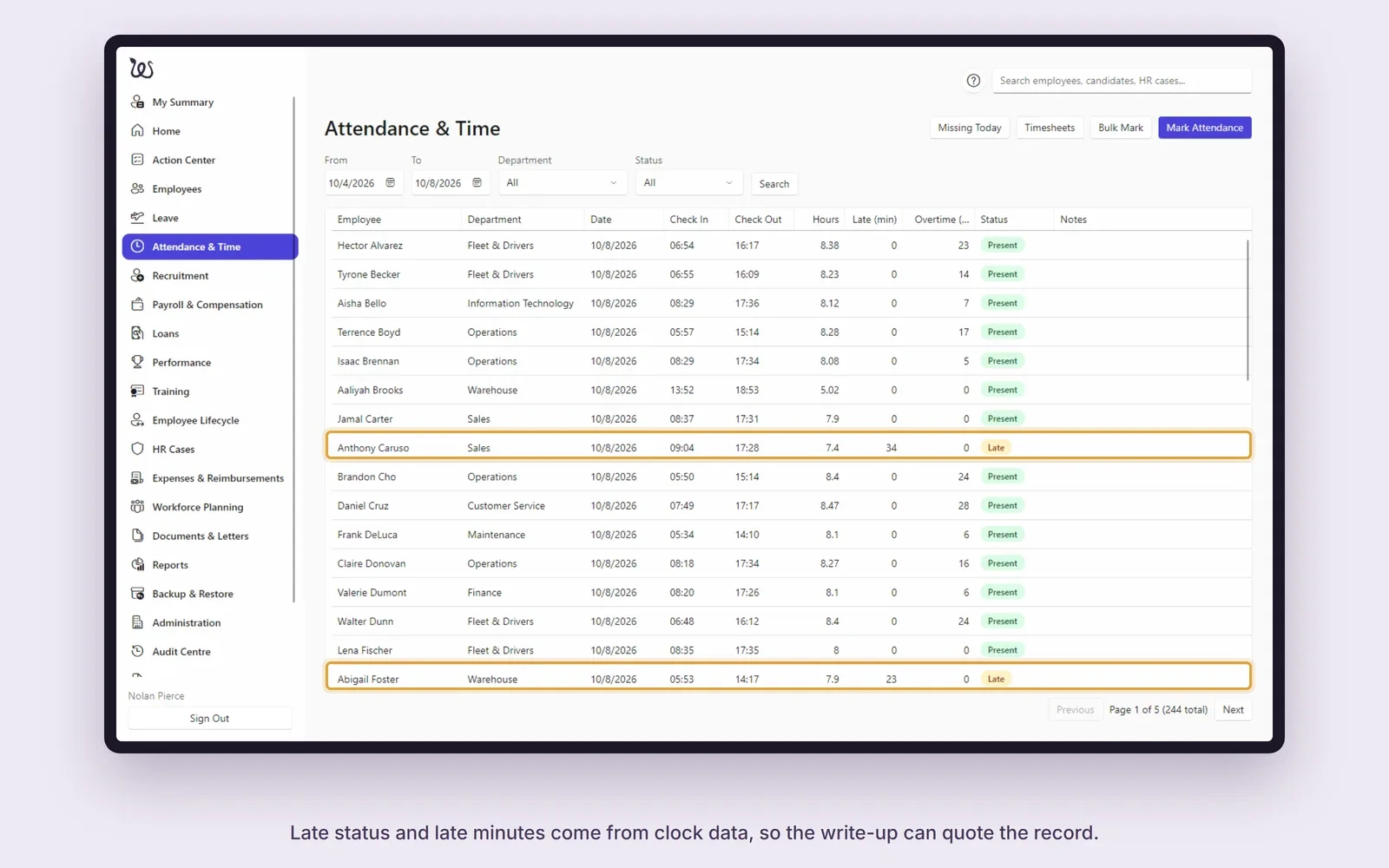
For lateness cases the facts come from attendance. HR Suite derives present, late, absent and on-leave status from clock data, and employees can review their own hours, late minutes and overtime. Staff can clock in on the Android or iPhone app, and the time comes from your company's server, not the phone. So the "What happened" field can quote the clock record instead of somebody's memory. If the concern is repeated short absences, the free Bradford Factor calculator scores them from real dates.
There's also an admin-viewable audit log of activity. What the app doesn't do: it doesn't decide whether a warning is fair, and it doesn't apply your country's discipline rules. The process is still yours.
Data stays on your own Administrator PC unless you choose Nagi Cloud. One company license includes 10 employee seats, 11 phone connections and unlimited employee records, for $19 a month, $190 a year or $349 once (our pricing page, 14 November 2026). If you write up one person a year, the Word form is enough.
Before you hand over the form
Check four things: the dates are exact, the rule is named, the consequence is written, and the review date is in a calendar. Then file it with the rest of the record using our personnel file checklist.
If the issue is performance rather than conduct, a performance review with goals may fit better than a warning. For someone still in their first months, the probation review template gives you confirm, extend or end options. See the letter and attendance features on the Nagi HR Suite page.
Frequently asked questions
- What should an employee write-up include?
The employee's name and role, the date of the write-up, what happened with dates and times, the policy or rule involved, earlier warnings, what must change and by when, what happens if it doesn't, the employee's own comments, and signatures from the manager and the employee, with a line explaining that signing means receipt.
- Does an employee have to sign a write-up?
No one can be forced to sign, and the signature usually only confirms they received the form, not that they agree. Say so on the form. If they refuse, write 'Employee declined to sign' with the date and time, and have a second manager or witness sign that note. The warning still stands.
- How many write-ups before termination?
There is no single number. A common policy is a verbal warning, a written warning, then a final written warning before dismissal, with serious misconduct able to skip steps. Write your own steps into the handbook and follow them the same way for everyone, because inconsistency is what a dismissed employee will point to.
- What is the difference between a verbal and a written warning?
A verbal warning is a conversation, usually the first formal step, which the manager notes on file with the date. A written warning is a signed document the employee receives, stating the problem, the expected change and the consequence. Both should be recorded; a verbal warning with no note is hard to prove later.
- How long does a written warning stay on file?
It depends on your policy. Many employers treat a first written warning as current for 6 to 12 months and a final warning for 12 months. In the UK, the Acas Code says the employee should be told how long the warning will remain current. Keep the record after it expires, marked as expired.
Sources
- USA.gov: Termination guidance for employers (at-will employment), checked November 14, 2026
- Acas Code of Practice on disciplinary and grievance procedures, checked November 14, 2026
- Fair Work Commission: What is the Small Business Fair Dismissal Code?, checked November 14, 2026
- Nagi HR Suite product page (letter templates, attendance, documents), checked November 14, 2026
The product in this post
Nagi HR Suite
HR, attendance, leave and payroll in one desktop application.
- write-up-form
- written-warning
- warning-letter
- discipline
- small-business