
Free Job Offer Letter Template (Word) and What to Put in It
A free job offer letter template in Word, the 12 parts every offer needs, a full sample for a salaried hire and a short one for hourly staff, and the US, UK and Australian rules that change what you write.
Nagi Software Team11 min read
A job offer letter puts the job title, start date, pay, schedule and conditions of a job in writing so the candidate can accept it with a signature. Our free Word template covers the 12 parts a small business needs, with a full sample for a salaried hire and a shorter one for hourly staff.
We make Nagi HR Suite, which generates offer letters from the candidate's record, so we've seen which missing lines cause the arguments later. The template is ungated: no email needed.
Download the offer letter template (Word)
The download is one Word file with two letters: a full offer for a salaried role and a one-page offer for an hourly or part-time role. Every field you need to change sits in [square brackets], and the notes at the end show which lines to delete for the UK or Australia.
Download the offer letter template (.docx)
It opens in Word, Google Docs and LibreOffice. Put it on your letterhead, fill the brackets, and save a PDF to send. If you would rather not touch Word, the free offer letter generator writes an offer from a few fields and lets you print it, save a PDF or open it in Word; our other HR builders are on the free tools page.
The 12 parts of a job offer letter
A complete offer letter has twelve parts, and most disputes start in parts 6, 7 and 11. Here is each one, what to write, and the mistake we see most often.
| # | Part | What to write | Common mistake |
|---|---|---|---|
| 1 | Date and candidate details | Date sent, full name, address or email | Using a nickname from the interview |
| 2 | Job title | The exact title on your org chart | A title that doesn't match the job ad |
| 3 | Reports to | Manager's name and title | Leaving it out, so day one starts with "who's my boss?" |
| 4 | Start date | A specific date and arrival time | "Early next month" |
| 5 | Location and hours | Address or remote, days, hours, shift pattern | No mention of weekend or on-call work |
| 6 | Employment type | Full-time or part-time; in the US, exempt or non-exempt | Calling an hourly role "salaried" |
| 7 | Pay | Amount, per hour/month/year, pay frequency | Mixing annual and monthly figures |
| 8 | Benefits and leave | Leave days, holidays, health cover, retirement, when each starts | Listing benefits that start after a waiting period as if they start on day one |
| 9 | Probation or introductory period | Length, review dates, what happens at the end | Promising "permanent" status after it |
| 10 | Conditions | References, background check, right-to-work documents, licenses | Running the check after the person has resigned elsewhere |
| 11 | At-will or notice terms | US at-will statement, or the notice period | A US letter that never mentions at-will, next to a UK-style notice clause |
| 12 | Acceptance | Deadline date, signature and date lines | No deadline, so the offer sits open for weeks |
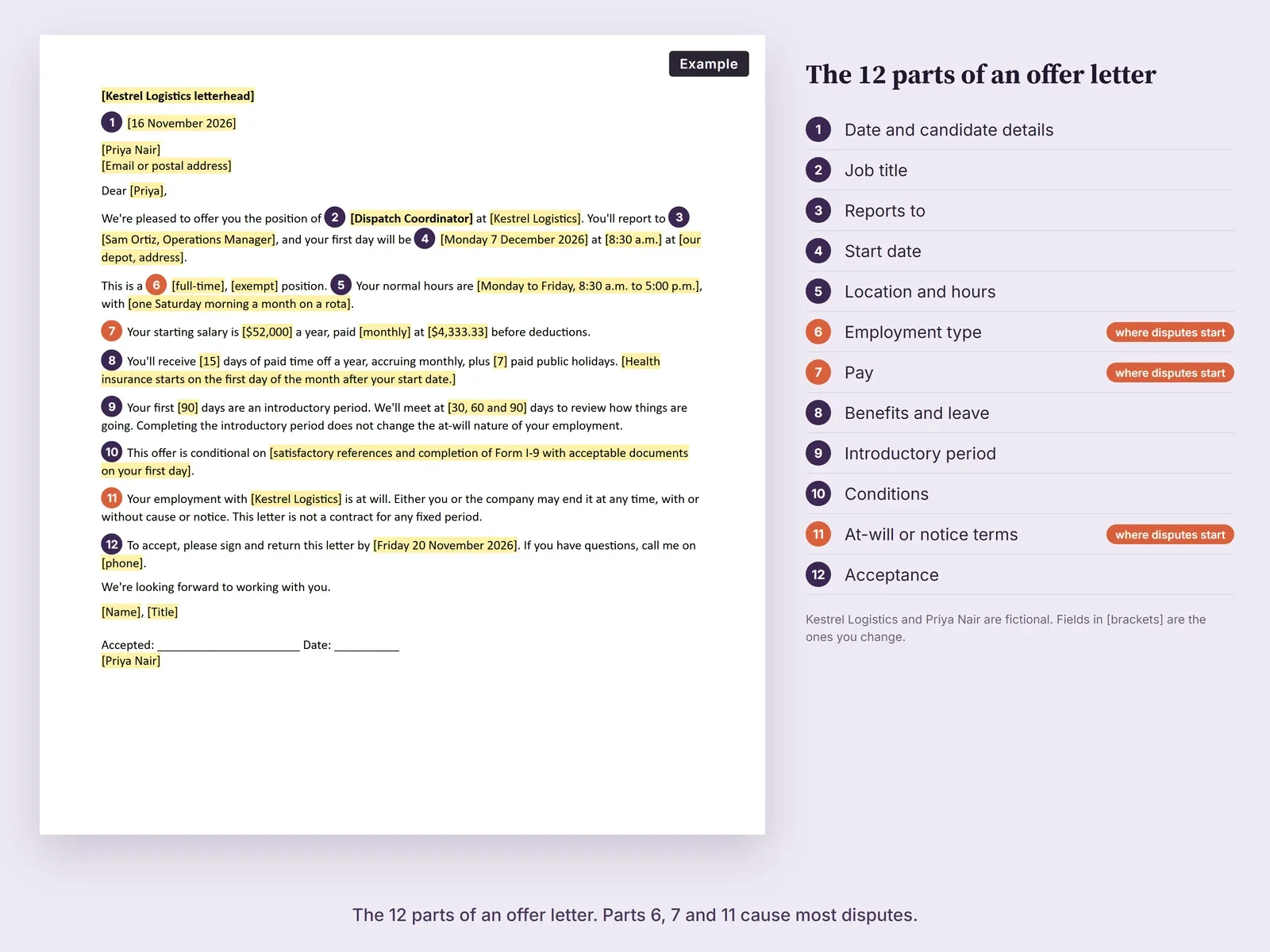
Part 7 deserves a second look. Write pay the way your payroll pays it. Monthly payroll? Then the letter gives the monthly figure and the annual total, and somebody checks with a calculator that one is exactly twelve times the other before it goes out. A letter that says "$52,000 per year" next to "$4,350 per month" has just promised $200 more than you meant.
How US, UK and Australian rules change the letter
The structure stays the same everywhere, but three countries' rules change specific lines. Few template pages split these out, so here they are side by side, each with the official source.
| United States | United Kingdom | Australia | |
|---|---|---|---|
| Can you end employment without a reason? | At-will: either side can end it at any time for any legal reason, in every state except Montana (USA.gov) | No; notice and contract terms apply | No; notice and unfair dismissal rules apply |
| Paperwork on day one | Form I-9 for every hire (USCIS) | A written "principal statement" of particulars on the first day (GOV.UK) | The Fair Work Information Statement, before or as soon as possible after the start (Fair Work) |
| Line to add to the letter | "Your employment is at will" and exempt or non-exempt status | Probation length and its conditions (the principal statement must include them) | The award or agreement that covers the role, if one does |
| Overtime wording | Non-exempt staff get at least time and a half over 40 hours a week (DOL) | As your contract sets it | As the award or agreement sets it |
In the US, an offer letter is often the only document a small employer gives, so the at-will sentence does real work. Keep it plain: "Your employment with [Company] is at will. Either you or [Company] may end it at any time, with or without cause or notice." Don't undercut it two paragraphs later with "after 90 days you'll become a permanent employee."
In the UK the offer letter isn't the legal minimum on its own. GOV.UK says the employer must give the principal statement on the first day, and it lists what goes in it: pay, hours, holiday, place of work, probation and more. Plenty of small UK employers write the offer letter so it already contains every item, then reissue it as the statement. That's one document instead of two.
Australian readers should treat the letter as a summary of the contract and the award. The award sets minimum pay and conditions for many roles, so quote the award classification you've used, and send the Fair Work Information Statement with the letter.
How to write a job offer letter
Writing an offer takes about 20 minutes once the pay and start date are agreed. Do the steps in this order so the letter matches what you said on the phone.
Step 1: phone the candidate first
Make the verbal offer, answer the questions about pay, hours and the first week, and agree the start date out loud, so the letter you send that afternoon confirms a conversation the candidate has already had instead of opening a fresh negotiation by email. It's faster too.
Step 2: fill the bracketed fields from one source
Take the title, manager and pay from your hiring approval or HR record, not from memory or the job ad. The usual wrong offer letter is a copy of the last one with one field left unchanged. Check pay and the manager's name twice.
Step 3: write pay both ways
For salaried roles, give the annual figure and the per-period figure. For hourly roles, give the hourly rate, the expected weekly hours and the overtime rate. Example: $22 an hour, 32 hours a week, overtime at $33 an hour (time and a half) for any hours over 40 in a week.
Step 4: state the conditions before the signature
List every condition the offer depends on: references, a background check, right-to-work documents, a driver's license for a driving role. If a check isn't back yet, say the offer is conditional on it. Don't let someone resign from their current job on an offer you might withdraw.
Step 5: set a deadline date
"Please sign and return this letter by Friday 20 November 2026." A date beats "within five days".
Step 6: send, then file the signed copy
Email a PDF, get a signed copy back, and put it on the employee's record the day they accept. The signed offer is the first page of their personnel file.
Sample offer letter: salaried role
This is the full letter in the download, filled in for the fictional Kestrel Logistics. Copy it, or take the Word file and replace the brackets.
[Kestrel Logistics letterhead]
[16 November 2026]
[Priya Nair] [Email or postal address]
Dear [Priya],
We're pleased to offer you the position of [Dispatch Coordinator] at [Kestrel Logistics]. You'll report to [Sam Ortiz, Operations Manager], and your first day will be [Monday 7 December 2026] at [8:30 a.m.] at [our depot, address].
This is a [full-time], [exempt] position. Your normal hours are [Monday to Friday, 8:30 a.m. to 5:00 p.m.], with [one Saturday morning a month on a rota].
Your starting salary is [$52,000] a year, paid [monthly] at [$4,333.33] before deductions.
You'll receive [15] days of paid time off a year, accruing monthly, plus [7] paid public holidays. [Health insurance starts on the first day of the month after your start date.]
Your first [90] days are an introductory period. We'll meet at [30, 60 and 90] days to review how things are going. Completing the introductory period does not change the at-will nature of your employment.
This offer is conditional on [satisfactory references and completion of Form I-9 with acceptable documents on your first day].
Your employment with [Kestrel Logistics] is at will. Either you or the company may end it at any time, with or without cause or notice. This letter is not a contract for any fixed period.
To accept, please sign and return this letter by [Friday 20 November 2026]. If you have questions, call me on [phone].
We're looking forward to working with you.
[Name], [Title]
Accepted: ______________________ Date: __________ [Priya Nair]
For a UK hire, delete the at-will and exempt lines, add the notice period both ways ("one week's notice during probation, one month after"), and name the probation conditions. For Australia, delete the same lines and add the award classification and notice terms.
Sample offer letter: hourly or part-time role
Hourly offers can be one page, and shorter is better here: rate, hours, overtime, start, conditions, signature.
Dear [Lena],
We'd like to offer you a [part-time] job as a [Warehouse Associate] at [Kestrel Logistics], starting [Monday 7 December 2026] at [7:00 a.m.]. You'll report to [Omar Haddad].
Your rate is [$22.00] an hour, paid [every two weeks]. You'll usually work [32] hours a week, [Monday to Thursday]. This role is non-exempt: any hours over 40 in a workweek are paid at [$33.00] an hour.
The offer depends on [completing Form I-9 on your first day].
Your employment is at will. Please sign below by [20 November 2026] to accept.
[Name], [Title]
Accepted: ______________________ Date: __________
Mistakes that turn into disputes
Most offer-letter disputes come from a promise the letter didn't mean to make. These are the ones to cut before you send.
- "Permanent position" or "job for life". In an at-will state this contradicts your at-will line; anywhere, it invites an argument about what "permanent" meant.
- A vague bonus. "Eligible for an annual bonus of up to 10%" is a different promise from "a 10% bonus". Say who decides and on what.
- A start date you can't meet. If the laptop, the uniform or the system login won't be ready, move the date. New hires decide what kind of employer you are on day one, and the offer letter is the first thing they read from you.
- Interview promises that never reached the letter, like "we'll review your pay after three months". If you said it, write it, or tell the candidate it isn't part of the offer.
- Two documents that disagree. If the handbook says 10 days of PTO and the letter says 15, expect to pay 15.
Generate offer letters from the hiring record
A Word template works well while you hire a few people a year. It gets risky when several managers copy last month's letter and edit it, because a stale salary or the wrong manager's name goes out with your signature.
In Nagi HR Suite the offer letter comes from the recruitment record. Candidates move through a hiring pipeline whose stages you configure, every stage change is kept in an append-only history, and offer and rejection letters are generated through the same letter template engine used for employee letters. You edit the template once; merge fields are filled from the real record when you generate the letter. The engine also holds appointment, confirmation, salary certificate, experience, warning, promotion, transfer and termination letters, so the offer and every later letter share one source.
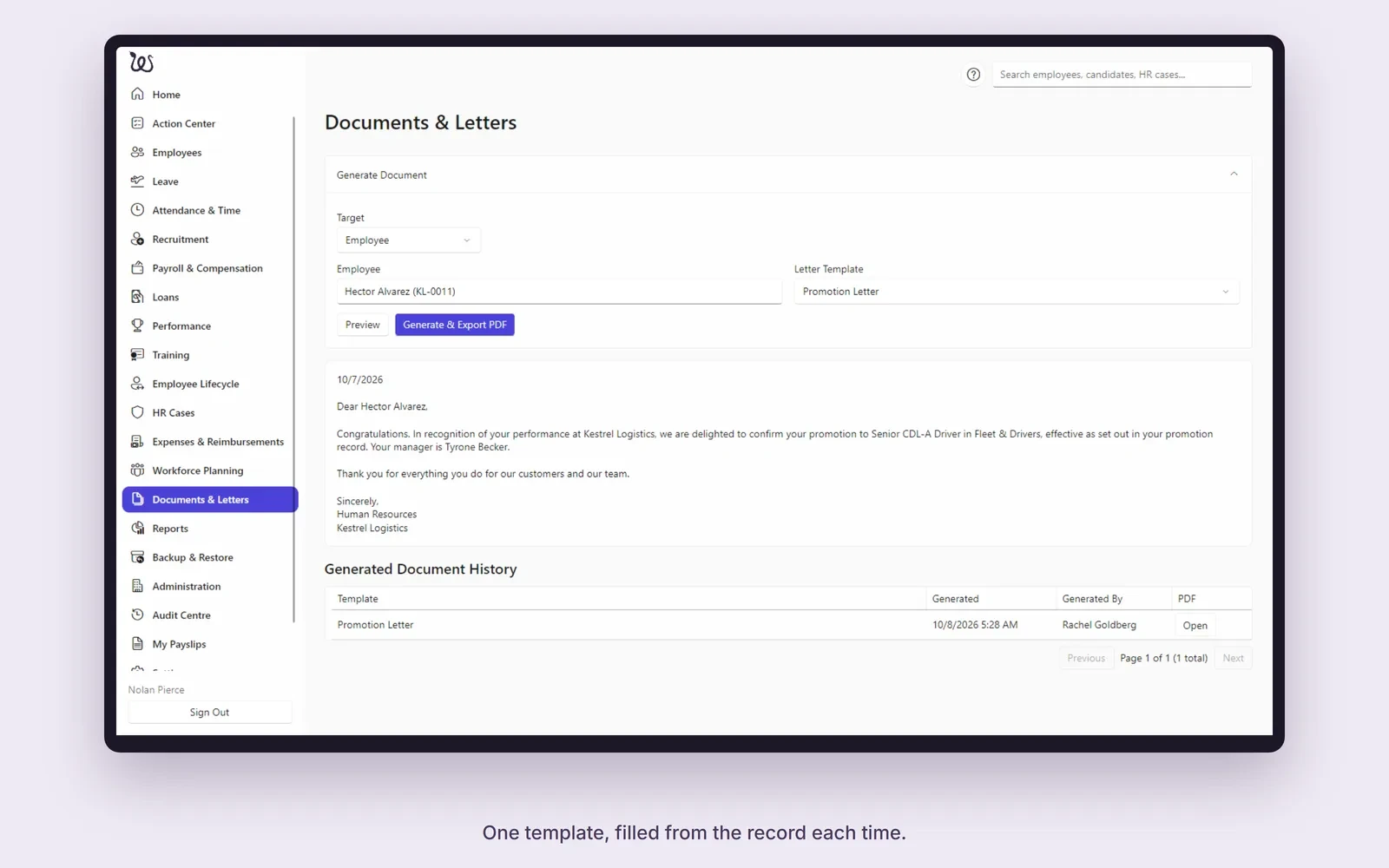
Once the person starts, their employee record keeps personal, employment and compensation details plus document attachments, so the signed offer lives next to everything else. Probation and confirmation are lifecycle events with a real effect on employment status, and they appear on one timeline per employee.
Two honest limits. E-signature is not included, so signing happens on paper or in your e-signature tool. And HR Suite doesn't decide what your country's law requires in the letter; the template text is yours.
The data stays on your own Administrator PC unless you choose Nagi Cloud. One company license includes 10 employee seats, 11 phone connections and unlimited employee records, for $19 a month, $190 a year or $349 once, as listed on our pricing page on 14 November 2026. Hiring twice a year? Then the free template is the better deal.
What to do after the offer is signed
The signed letter starts the file; the next documents follow from it. Book the 30, 60 and 90-day check-ins on the day the offer is accepted, so the introductory period actually gets reviewed. Our probation review template has the form and the confirm, extend or end letters, and the free new hire onboarding checklist builder turns the start date into dated tasks with an owner each.
File the signed offer with the rest of the record using the personnel file checklist. And when the person eventually leaves, the same details feed the experience letter and salary certificate. See the recruitment and letter features on the Nagi HR Suite page.
Frequently asked questions
- What should a job offer letter include?
The job title, who the person reports to, the start date, work location and hours, full-time or part-time status, pay and how often it's paid, benefits and leave, any probation or introductory period, conditions such as a background check, the at-will or notice terms, and a deadline and signature line for accepting.
- Is an offer letter legally binding?
It can be, depending on what it says and where you are. In most US states employment is at will, and a letter that says so is usually read as an offer, not a contract for a set term. Outside the US, notice and contract rules apply, so the wording carries more weight. Have a local employment lawyer check your standard wording once.
- What is the difference between an offer letter and an employment contract?
An offer letter is short and sets out the main terms so the candidate can say yes. An employment contract is the full agreement: duties, notice, confidentiality, restrictive terms and policies. Small US employers often use only an offer letter. In the UK, the day-one written statement covers much of what a contract would.
- Can you send an offer letter by email?
Yes. Most offers now go out as a PDF attached to an email, and the candidate signs electronically or returns a scanned copy. Phone the candidate first with the offer, then send the letter the same day so the details match what you said. Keep the signed copy on their employee record.
- How long should a candidate have to accept a job offer?
Three to five working days is common for most roles. Give a date, not a number of days, so nobody argues about when the clock started. If the candidate asks for more time to consider another offer, a short extension in writing is usually better than losing them.
Sources
- USA.gov: Termination guidance for employers (at-will employment), checked November 14, 2026
- USCIS: Form I-9, Employment Eligibility Verification, checked November 14, 2026
- US Department of Labor, Wage and Hour Division: Overtime pay, checked November 14, 2026
- GOV.UK: Written statement of employment particulars, checked November 14, 2026
- Fair Work Ombudsman: Fair Work Information Statement, checked November 14, 2026
- Nagi HR Suite product page (recruitment, letter template engine), checked November 14, 2026
The product in this post
Nagi HR Suite
HR, attendance, leave and payroll in one desktop application.
- offer-letter
- job-offer-letter
- hr-templates
- recruitment
- small-business